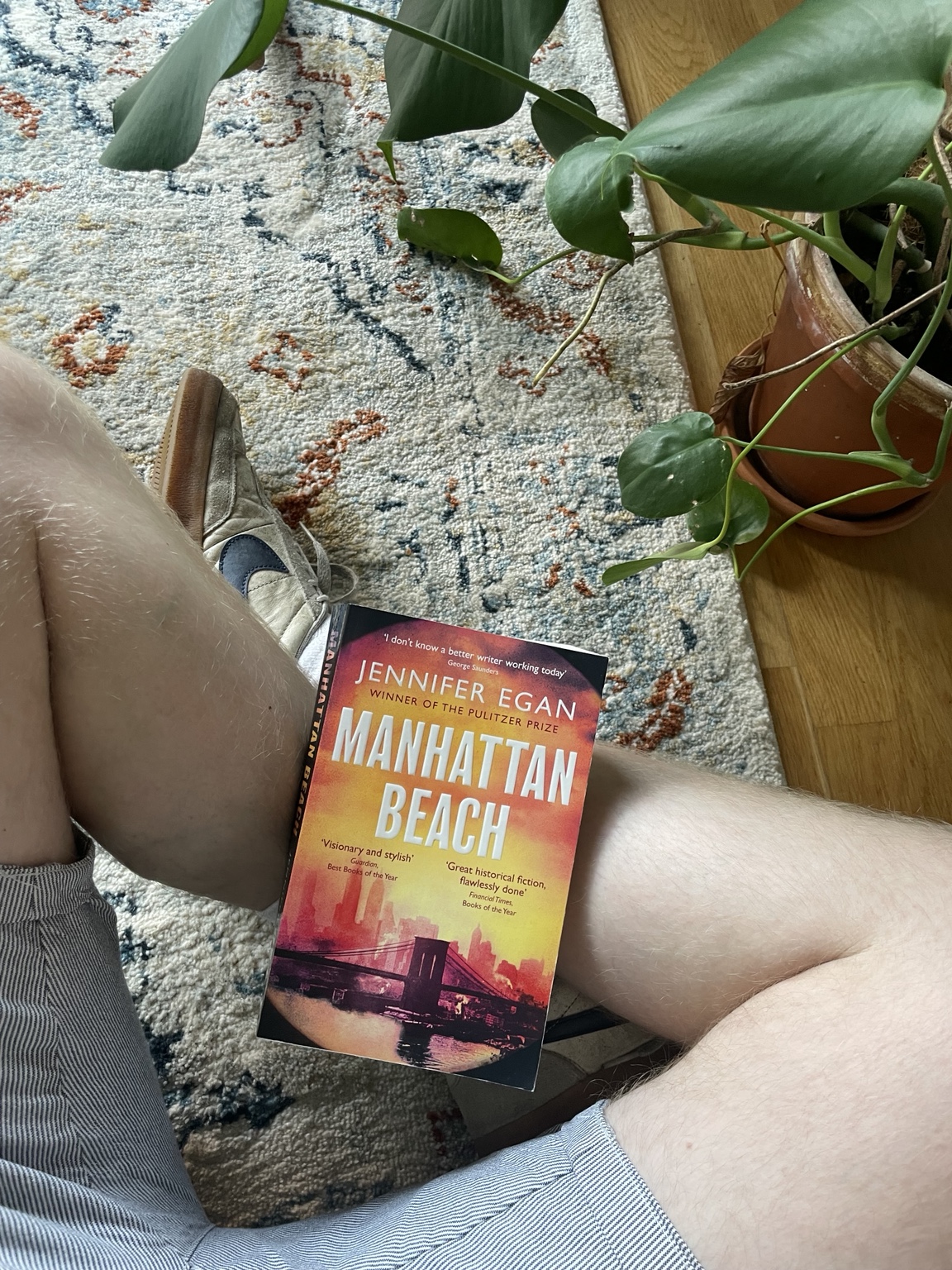
I had the pleasure of discovering Jennifer Egan’s Pulitzer Prize winning A Visit From the Goon Squad in 2022 and had it down as my most likely favourite read of the year. When I set about picking some of the books which would comprise my 52 in 52 effort this year, I was excited to pack it full of as much Egan as possible; fill me with Egan sir.
However Manhattan Beach is no A Visit From the Goon Squad, this is both for its sins and benefits. It’s more traditional in scope and narrative; being primarily an historical novel telling the story of an ambitious woman who is determined to take as much as possible from the leverage she’s been dealt by the alternative bigotry arising from Europe.
The driving plot within the novel has enough mystery to encourage long spells of unbroken reading. It manages this without being too consuming, which allows you to be seduced by the intrigue but really savour the painstaking research apparent in the construction of the set piece that contains the action.
Whilst making my way through number two on the list, which was also set in Brooklyn (modern and naval yard free), I realised that I’d managed to read three consecutive Brooklyn-based writers in a row. Clearly the left-leaning politics within gentrified historical housing stock brings all the writers to the Brooklyn Naval Yard. Snarkiness aside, it’s Egan’s attention to detail in showing you how this iteration of Brooklyn would have felt, smelt and been lit that elevates the reading experience. It feels like backdooring into a documentary on US Naval Yards and World War II while getting your pulpy mystery-novel fix: exemplary historical fiction.
I’ve read that this was achieved through ten years of research at the numerous institutions acknowledged at the end of the book; confirming that, snarkiness or not, the author has a deep-rooted affection for her home.
The real skill of the story is the creation of a Russian Doll-esque piece of literature that shows you a 1930s gangster mystery novel only for it to crack open to reveal a story about a young woman breaking into a masculine environment, which reveals an examination of the American nuclear family, in turn containing a rumination on loneliness. Imagine, if you can, a series of stories written separately on tracing paper, then overlaid to create a broad intertwined whole, each contributing to the depth of the other.
The whole collection is imbued with an emotional core grounded in the father-daughter relationship between Anna and Eddie Kerrigan and how both fall into the orbit of a local mobster — community business leader. The setup begins with Anna accompanying her father on a business trip to the eponymous Manhattan Beach home of Dexter Styles, the third protagonist who provides the connection between Anna and Eddie after he disappears.
In keeping with the desire to tell a clear and broad narrative illustrative of the period, we meet Irish union bosses, Italian moonshine runners and WASP upper classes of American society. A skill is that all these characters express both varied and aligned attitudes to the state of America through the novel.
One of those accepted truths that had always swum about somewhere in my head was that the loss of working-age men in Britain had led to a necessary broadening of the workforce, which meant women were allowed the emancipation of relying on men to be the providers.
What I hadn’t always interpolated from that was that a war started through hatred had led men in all parts of the world to reckon with their hatred towards women. This reckoning with societal norms is another ingredient that Egan folds into the batter of her literature cake.
The strength of Anna really comes alive in the scenes in which she bears the weight of the full diving outfit, two hundred pounds of heft that push her alone down into the depths of Wallabout Bay. The neatness and simplicity of the suit as a metaphor encapsulates what Jennifer Egan has accomplished here: blending thoughtfulness with fun, allowing the reader to measure how much they want to take from the offering.