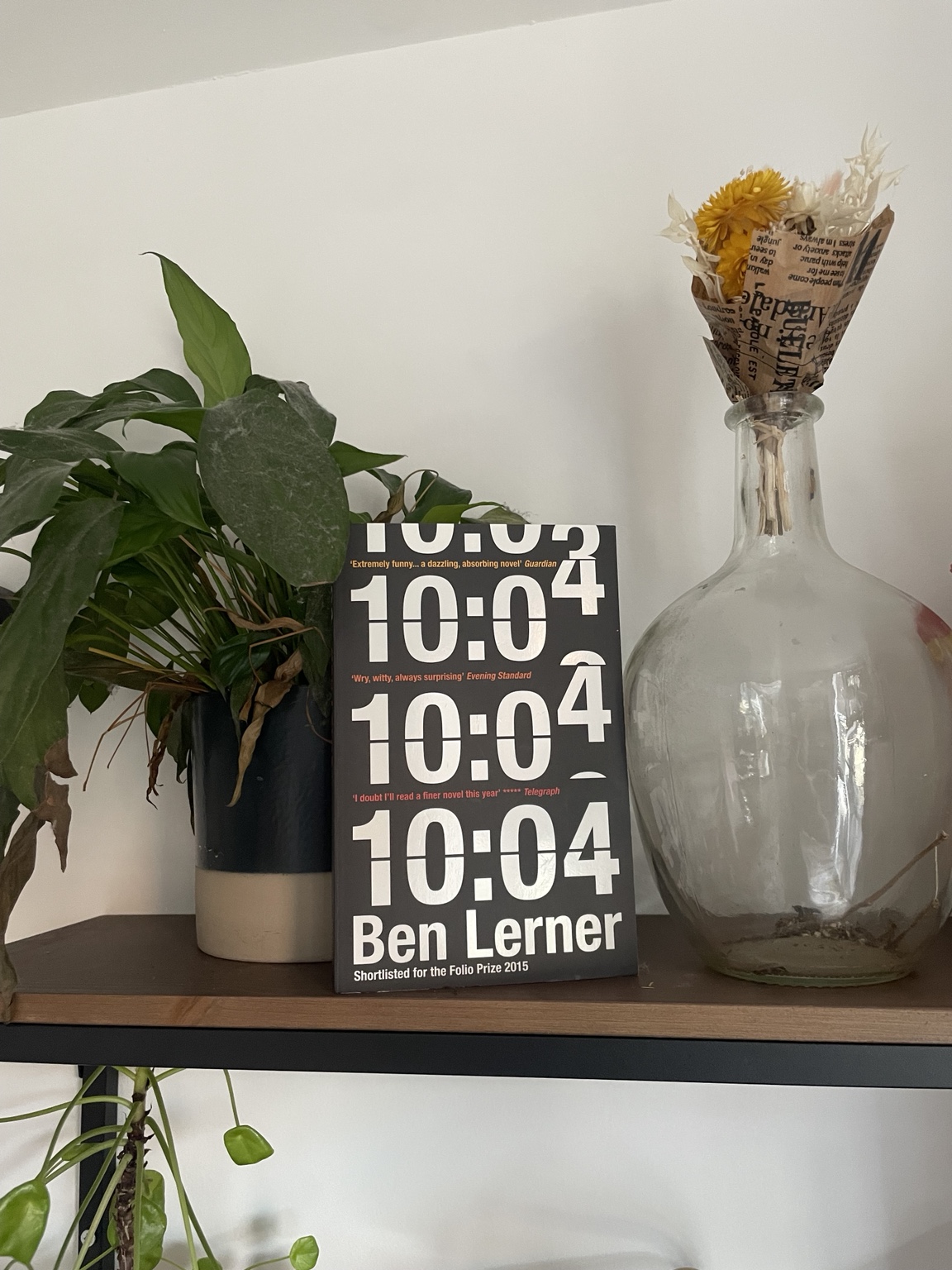
Forty eight. The opening blockbuster of a sentence in this book contains a girthy forty eight words. Not to be outdone, it’s one of the shortest of the opening six sentences. I was once told by an ex-journalist that the perfect sentence length to engage but not overwhelm was a tight nineteen words; you get the feeling Lerner had been told that too.
Ben Lerner uses these chewy, gristly, overwrought sentences to establish the meta tone of this unusual novel from the very start. You could say it’s an economic achievement to convey the ambition of your novel within the first six sentences, capped off by its culmination in a wry joke, but when two of them number over seventy words you lose all claim to being a fiscally sound wordsmith.
This book tells the story of a poet with a well-received first novel attempting to wrestle a critically appreciated short story into what some hope will become a commercially successful novel. Lerner, of course, is a poet turned author of Leaving the Atocha Station — my favourite read in 2020 — who had an identical short story to the one in the novel published in the New Yorker and, like the novel’s author, dwells in Brooklyn. Got it?
I’ve always been a fan of memoir/fiction. I’ve had a poster of Kerouac’s On the Road cover in my living room for ten years — not a brag, but a confession of a lack of imagination. Lerner is considered to be a purveyor of the same, but different, autofiction. Being a non-learned fellow, I couldn’t articulate the differences for you here. As I see it: author writes about their life; but it’s not all true or not all untrue — discuss?
I’ve seen Lerner’s books referred to as works of metafiction; with its dragon-swallowing-its-tail-like complexity, that is a tag I’d greedily affix to this novel.
In the absence of a gripping plot or obvious character journey, it’s a structured peeling back of the curtain to the writing process which keeps you on the hook. It opens to reveal a story that was always on the cusp of appearing, until you realise it had been there all along.
It deliberately makes you question the reality of the words you’re reading; the aforementioned article is included in its entirety. Its inclusion allows you to contrast the author’s described reality to date against the published reality of the article. You form your own opinion as to how Lerner may have altered his truth to form that of the novel’s author, illustrating that the truths which did make it into the book have been similarly chopped, dissected and remade.
I recall once attending a lecture which made the postmodernist argument that, despite its claim to be a realistic image, even a photograph was a representation of reality and as such could not be relied upon as truth. In 2023, with manipulation of reality rife on social media and AI-aided image and video creation ubiquitous, this is hardly an idea that isn’t shared by large numbers of people. In the years this book was written and takes place in, it’s an idea that seems to have inspired and looped the book and its telling.
The meta approach to storytelling is not all deep rumination on postmodern reality; at times it’s used for humour. There is a memorable exchange between author and agent, the agent imploring the author to consider approaches to reach a wider audience. No sooner do we hear that ‘describing faces of those at the next table’ is a sure-fire way to do that, the adjacent quartet becomes increasingly garrulous.
If Manhattan Beach is a Parasite-adjacent novel, building intellectual provocation into the kind of storytelling that is essential to a book-club sticker, then 10:04 is a French art film beloved of those who inhabit all the Brooklyns around the world: unashamedly clever but not flashy.