Earlier this week I exited a conversation with the refrain ‘thanks friend’; unremarkable, you say, but this was at work. The reply came quickly, laced with mischief: ‘no problem colleague’. We spend a large amount of time at work, amongst personalities not of our choosing, and this necessitates a form of forced relationship.
Like many others I first came across Convenience Store Woman, Murata’s first book to be translated and published in the UK, by virtue of its pop-pink cover with ubiquitous fish-shaped, snack-sized soy sauce packet.
I misrepresented: I didn’t find it myself, my fiancée did. She saw that cover and proverbially judged it. I’m grateful she did; thanks to that book’s cover I was introduced to a fascinating novelist. She took the story of a happy, hard-working convenience store worker and leveraged it to challenge perceptions about normality in society.
Far from being the cutesy story it might have seemed, it allowed you to examine expectations placed upon people by society, mostly unconsciously, and shine a light on the demands of femininity in Japanese culture. It managed this whilst making you care about Keiko and her future. While the story is rooted in the author’s experience of Japanese society, it feels like an applicable parable to swathes of twenty-first-century life.
From this I bought her next book, Earthlings, when it came out in hardback instead of patiently waiting the usual six months for the paperback. This was a shockingly brutal tome, unflinching in its portrayal of a family rocked by scandal, which illustrated how society rejects its social contract and abandons the vulnerable to protect the herd. In a twist, it manages this without a saccharine protagonist.
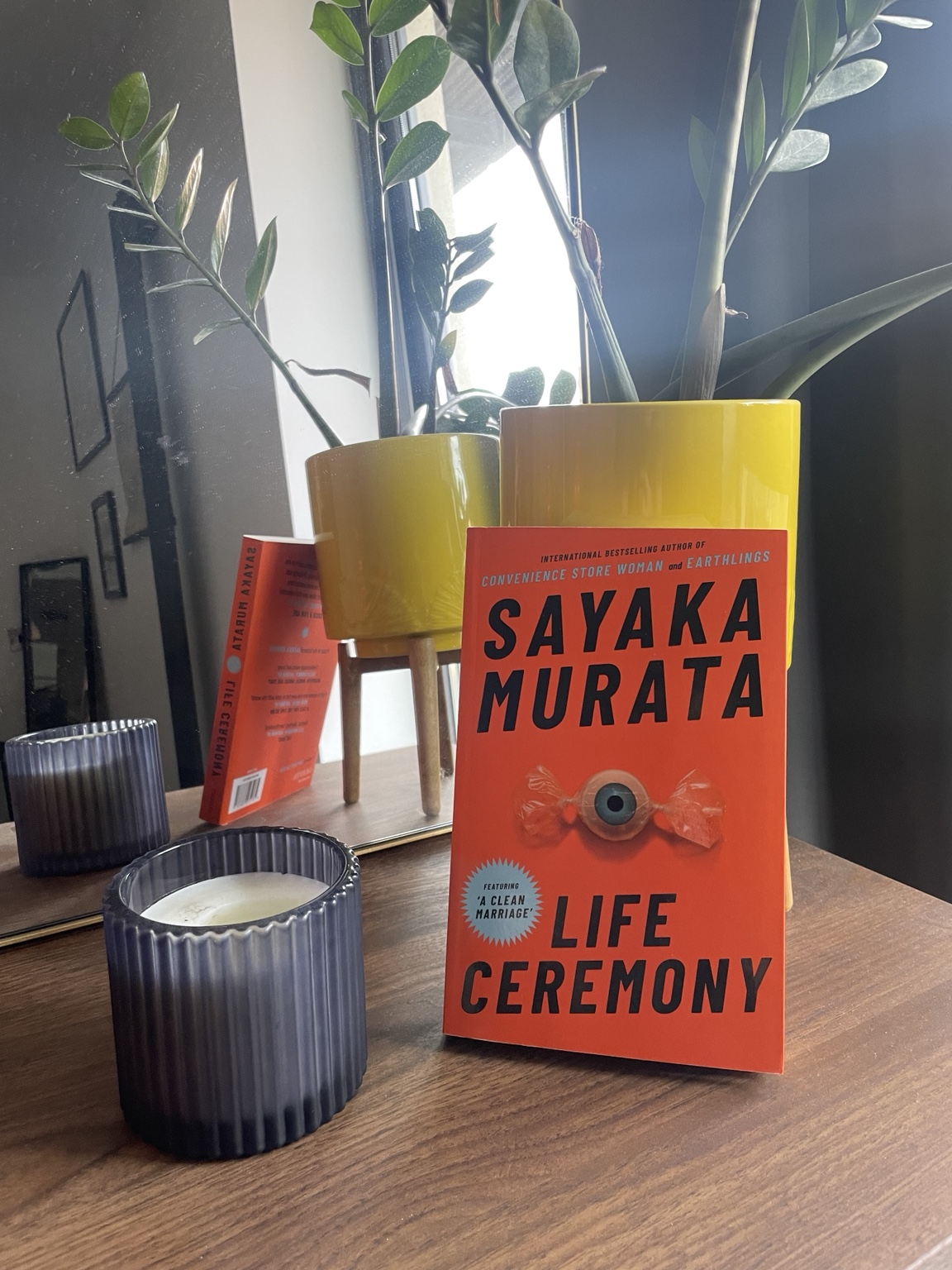
The front cover of Life Ceremony speaks of the inclusion of ‘A Clean Marriage’. This was Murata’s first piece of writing to be translated into English and anchors this collection. The translation is by Ginny Tapley Takemori; as a short story it offers a blueprint to the reframing of a societal norm that would become her stock in trade. It takes the exclusively female experience of childbirth and strips back the mystique to the undignified posture it requires; how would this look upon a man?
Reading through these stories, I feel that Murata has three recurring themes which bleed through the book and, by extension, her larger novels.
The first is a general bemusement of others by the person who would usually arouse bemusement. This is found in Puzzle, Lover on the Breeze, Body Magic and Eat the City, and perhaps is the kernel in all the narratives. It’s the outsider who frames ‘normality’ as absurdity. Perhaps it reflects the lived experience of someone who has worked part-time in a store, with ten thousand hours of people-watching to hone their craft.
A second is the juxtaposition of the urban dweller and the country outpost. Most of Murata’s characters live in large Japanese cities such as Kobe or Tokyo, but there remains a preoccupation with the ‘simple life’ of the country. As a man who’s never been near, Japan’s pop-culture image vacillates between a futuristic Blade Runner precursor and the feudal, mystical way of samurai spiritual culture. These are often in opposition; one is unsure of the other.
Finally, circling round to the clumsy opening paragraph, it’s the forced relationship that bounces off the page. So many of these tales involve a workplace-adjacent story as the epitome of societal acceptance of a relationship based on context and proximity. Other forced relationships are shown, but it’s the colleague which appears again and again.
Overall I find that I greatly prefer the prior two novels. The focus required by the brevity of these stories doesn’t allow for as much subtlety; instead, it can be like being clubbed by a metaphor. Smacked by a simile?